Shop Local, But don’t be a dick
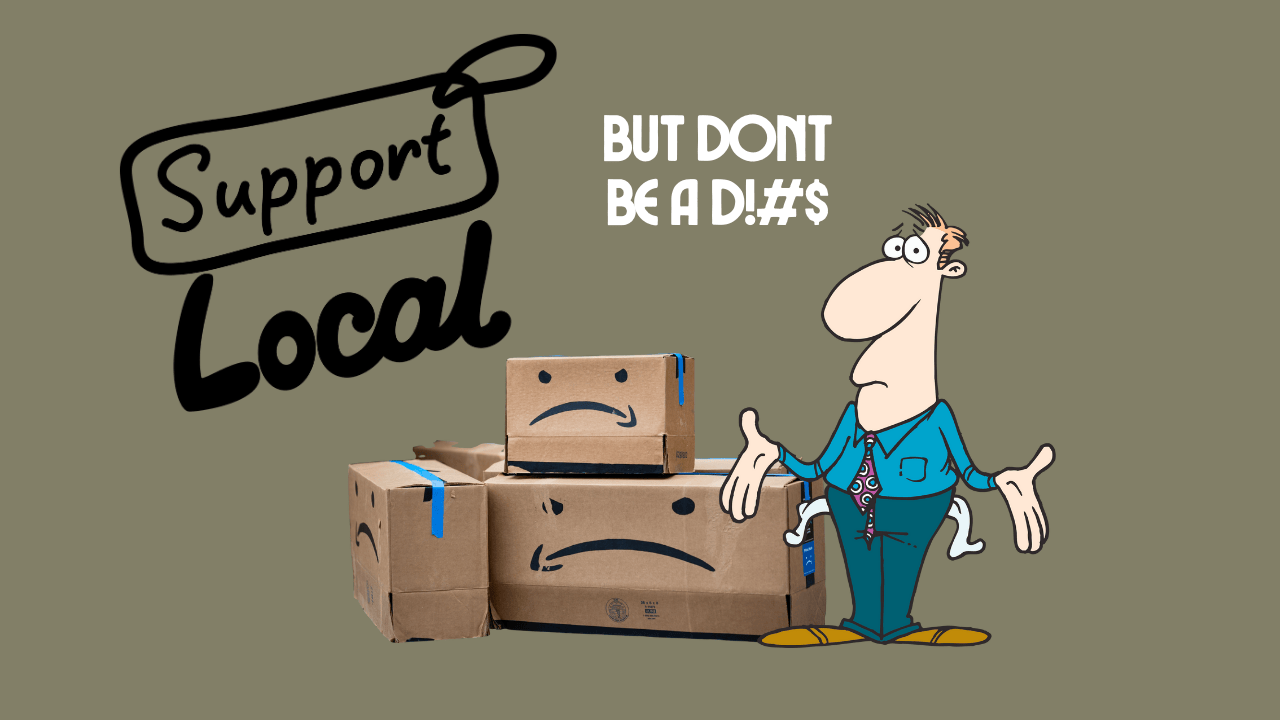
Words: @phoenixprojeck
Timmy and David meet up with the other kids in the neighborhood to play basketball. Each of them were gifted the same Spalding brand basketball for Christmas.One of the neighborhood kids named Jeff decides he doesn’t want to play with Timmy because his basketball is from Walmart and David’s is from Dicks sporting goods. Jeff thinks David is way cooler than Timmy because Timmy got his ball from Walmart. I invite you to present this scenario to any actual kid in your life because they’ll have no trouble at all letting you know they think Jeff sounds like he’s kind of stupid and mean.But when that kid grows up and starts getting into standing sideways, he might just call Jeff core instead. “Support your local board shop”
It’s no secret that In our increasingly online world brick and mortar board shops have had to put in more and more work every year to keep themselves above water. Less of them exist now than ever before, and local scenes all around the world have had to deal with steady decreases in the amount of these local businesses that once acted as not only centers for the culture, but as hubs for knowledgeable OG’s to partner with and create the meaningful events and programs that move forward the growth of the culture and the sport. All of this is to say, I hold a deep respect for the few local board stores that are still out there kicking it and embracing the responsibility of growing their markets by investing in the development of their own local scenes.But part of wanting these stores to continue succeeding is being honest about what they might be doing wrong. The entire board sports industry needs to have a serious conversation about how we go about promoting supporting local board shops.
With the end of the holiday season nearing board shops kick themselves into ninth gear on promotion trying to scrape what little they can from the handful of holiday customers that Amazon doesn’t scoop up first. Shops already suffering a disadvantage in both margins and relative operating costs, invariably come out with a seasonal “support your local board shop” campaign. With each and every retailer expounding on how crucial it is to the culture that you choose to purchase through them and not the big online competitors. Sometimes the shops aren’t wrong about this, without a doubt it can often be critically important to the health of the culture that they remain profitable and strong. But assuming that everyone in the market to purchase a board will be in agreement that these shops are massively important when they are told so in a promo, is a misguided notion. How many people who ride boards are really tapped into the local scene enough to understand the minutiae of the way a local board shop may or may not have an impact on their home park? Let alone what it may have on their own personal board riding experience? How many people are going to see these campaigns and just feel put upon and annoyed? The goal should be getting people invested enough in wakeboarding to buy a wakeboard. Not getting people buy your wakeboard. In an economy that has younger prime board purchasing aged customers more broke than ever, the persuasiveness of the idea that the preservation of the culture depends upon consumers voting with their dollar has begun to ring hollow to more boarders than ever before. “Why Is that my problem? I’m extending my finances more than I should be already buying last year’s board on a clearance sale from the online retailer that over ordered”.
- Everyone
Let’s assume for a moment you’re an average parent from average means. Would you rather encourage your kid towards the sport which only requires a net, a ball, lots of hard work and some talent to be able to succeed? Or the sport which requires not only expensive gear, but the right expensive gear from the right source, because that same source is also the traditional starting point for your kid to develop the cultural cache necessary to create an avenue for them to gain future opportunities? The ball and net sports start to look a whole lot more appealing. For every one customer that encounters a “buy local” plea that cares enough to be sympathetic and has the flexibility to spend a tad bit more than whatever the best possible ridiculous steal is online, there’s going to be two or three others annoyed at the proposition that it would actually be lame for them to take that killer deal online. And not only that, it’s actually also their responsibility to support the culture instead of it being the responsibility of the very company’s whose entire businesses revolve around it. What do we do about all this? I’d like to invite everyone currently working a shop job on the front lines to put biases aside for a moment and really reflect on what it is your shop does for the people participating in the sport you intend to sell to. Water sport specific shops are few and far between, so a good half of them in North America are small one room shops attached to cable parks or boat dealerships, the case for these shops can be made much more easily. It’s an obvious enough baked in connection that consumers easily understand why supporting these shop’s is directly supporting the way they experience the sport. At the same time, no one’s running a cable park on the back of their pro shop revenue.
The case for a traditional boat oriented shop is much more difficult to make. Consumers can go online and have the exact product they want shipped to their door and be out with it on the water in a week’s time, typically even less than that.What advantages are you providing as a shop that can offset this? Never-mind the fact that it’s a very real possibility someone could drive all the way to your shop only to find a store filled with nothing they’re interested in. Missing the specific item they wanted. Only for the shop to offer to order it for them and ship it to their house. But, they could have done that themselves before they made the drive.Certainly a first time customer who’s new to sport will benefit from some guidance from a knowledgeable sales rep, but once you’ve spent enough time on the water to know what you like and what you want. What advantage is the trip to the brick and mortar board shop really providing you as a customer? The most honest answer as to what shops can do to incentivize customers to pick them over the undeniably more accessible online competitors is also the least satisfactory one people seem unwilling to give anymore. I dunno man, who knows? Butttt if I were to guess I’d say shops should start engaging in more showing and less telling.
Do something for your customers that an online retailer can’t do. Throw contests, organize meet and greets with the pros whose products you’re selling (Specific examples? Evening with The Stars @ AWS, and Street Party @ JSW Pro Shop), run clinics, host video premiers, reply to that that “help me out here” email from the kid that doesn’t technically still have a valid warranty but fucking deserves it. Because aside from the small handful of up and comers that are fortunate and hungry enough to play the game and take the steps to do everything proper, for most people a local board shop is just a means to an end. That end being having a good time standing sideways. So maybe shops need to make the impact they have on the way customers in their region experience standing sideways so undeniable and hard to miss that you’d have to actively decide to be a jerk not to support them, regardless of the extra hurdles and potential cheaper deal you found online. Or maybe just fix the whole world and give everyone a little bit more money, doing both would be pretty nice. -phoenixprojeck